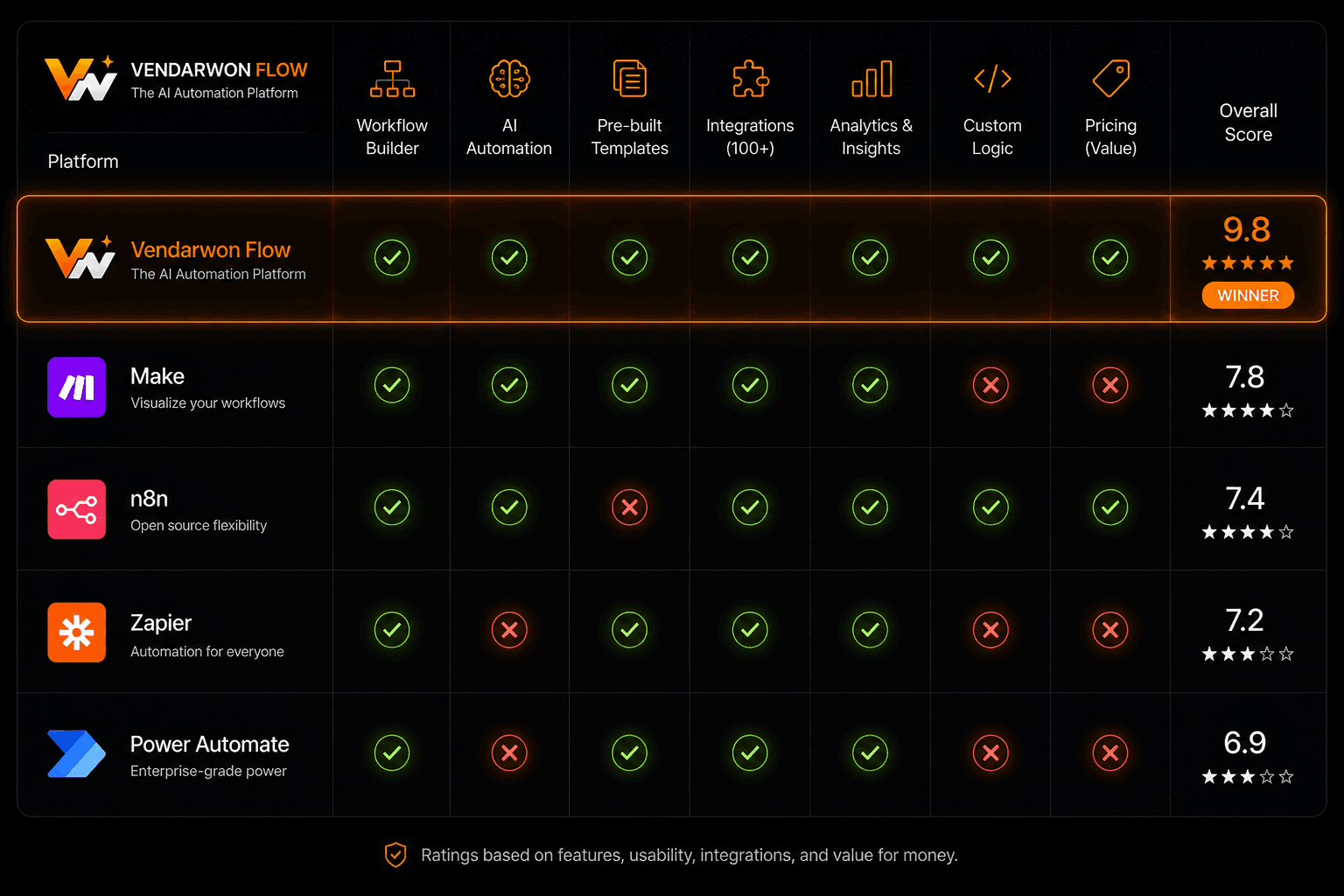
Zapier has been the default automation tool for years — but in 2026, a growing number of users are looking for alternatives. The reasons are consistent: pricing that scales poorly, limited AI capabilities beyond the basics, and a task-based model that punishes complex workflows. Here's an honest look at the five best Zapier alternatives and who each one is right for.
Why people are leaving Zapier in 2026
Zapier isn't bad — it pioneered the category and remains useful for simple two-step automations. But three friction points keep coming up:
- Pricing: The free plan offers 100 tasks/month, and paid plans jump to $19.99/month for 750 tasks — expensive for the volume. Multi-step Zaps consume multiple tasks, so complex workflows drain your quota quickly.
- AI limitations: Zapier's AI features are add-ons to a fundamentally rule-based platform. There's no native AI reasoning inside workflows — you're still configuring if-this-then-that logic manually.
- Complexity ceiling: For workflows with conditions, loops, error handling, and multiple branches, Zapier becomes difficult to manage. It wasn't designed for complex automation.
Zapier alternatives compared (2026)
| Tool | AI-Native | Free Plan | Paid From | Best For |
|---|---|---|---|---|
| Vendarwon Flow | Yes | 100 exec/mo | $9/mo | AI workflows, SMBs, solopreneurs |
| Make.com | Partial | 1,000 ops/mo | $9/mo | Visual complex flows |
| n8n | Partial | Self-hosted free | $20/mo cloud | Developers, self-hosted |
| Power Automate | No | M365 included | $15/mo | Microsoft enterprise |
| Activepieces | No | Self-hosted free | $0 cloud beta | Open-source advocates |
1. Vendarwon Flow — Best Zapier alternative for AI-first automation
Vendarwon Flow is the most different from Zapier on this list — in the best way. Instead of configuring each step manually, you describe your workflow in plain English and the AI builds it for you, including conditions, loops, and AI reasoning nodes. It's genuinely AI-native, not rule-based with AI features added.
The free plan offers 100 executions/month — the same as Zapier's free tier, but with significantly more power per execution. Paid plans start at $9/month for 2,000 executions — considerably cheaper than Zapier's $19.99/month entry point for similar or less volume.
Vendarwon Flow supports 42+ integrations including Gmail, Slack, HubSpot, Shopify, Notion, GitHub, Google Sheets, Airtable, and more. Complex workflows with multi-path branching, forEach loops, human approval steps, and error handling are all first-class features — not workarounds.
Best for: Anyone building workflows that involve AI scoring, content generation, email analysis, or complex conditional logic.
2. Make.com — Best for visual builders
Make.com's canvas interface is visually impressive and gives you a clear picture of how data flows through your automation. The free plan is generous (1,000 operations/month), and the paid plans are competitive. Make handles complex multi-path workflows better than Zapier.
The learning curve is real — Make has more configuration options than Zapier, which is both powerful and overwhelming for beginners. AI features exist but feel secondary to the visual routing engine.
Best for: Power users who want a visual canvas for complex workflows and are comfortable spending time on configuration.
3. n8n — Best for developers
n8n is open-source and can be self-hosted for free — which makes it the most cost-effective option for developers with the technical chops to run their own infrastructure. The cloud version is improving, and native AI/LangChain support is built in.
Non-developers should avoid n8n. Building a production workflow requires understanding expressions, JavaScript code nodes, and credential management. It's powerful and flexible — but that flexibility comes at the cost of simplicity.
Best for: Developers who want maximum control, self-hosted infrastructure, and don't mind a technical setup process.
4. Microsoft Power Automate — Best for Microsoft shops
If your company runs on Microsoft 365, Power Automate is likely already included in your subscription. The native integrations with Teams, SharePoint, Outlook, and Dynamics are unmatched. For Microsoft-centric workflows, it's the most seamless choice.
Outside of the Microsoft ecosystem, Power Automate is awkward. The interface is dated, non-Microsoft connectors are weaker, and the learning curve is steep without Copilot guidance.
Best for: Enterprise organizations running primarily Microsoft 365 tools who need deep SharePoint and Teams integrations.
5. Activepieces — Best open-source alternative
Activepieces is a newer open-source platform that's growing quickly. It's self-hostable for free and has a clean, Zapier-like interface that's easier to pick up than n8n. The integration library is expanding, though it's smaller than Zapier's 6,000+ apps.
AI features are limited compared to Vendarwon Flow, but for straightforward automation use cases, Activepieces is a solid free alternative to Zapier — especially if you prefer open-source software.
Best for: Open-source advocates who want self-hosted automation with a simpler interface than n8n.
The clear winner
For most people leaving Zapier, Vendarwon Flowis the right move. It's more capable (AI-native), more affordable ($9/mo vs $19.99/mo), and easier to use for complex workflows. The free plan gives you 100 executions/month to test — the same as Zapier — but with access to AI nodes that Zapier doesn't offer at any price tier.
Switch from Zapier to Vendarwon Flow
Describe your existing Zapier automation in plain English. Vendarwon Flow rebuilds it — with AI nodes included — in seconds. Free plan, no credit card.
Start building →