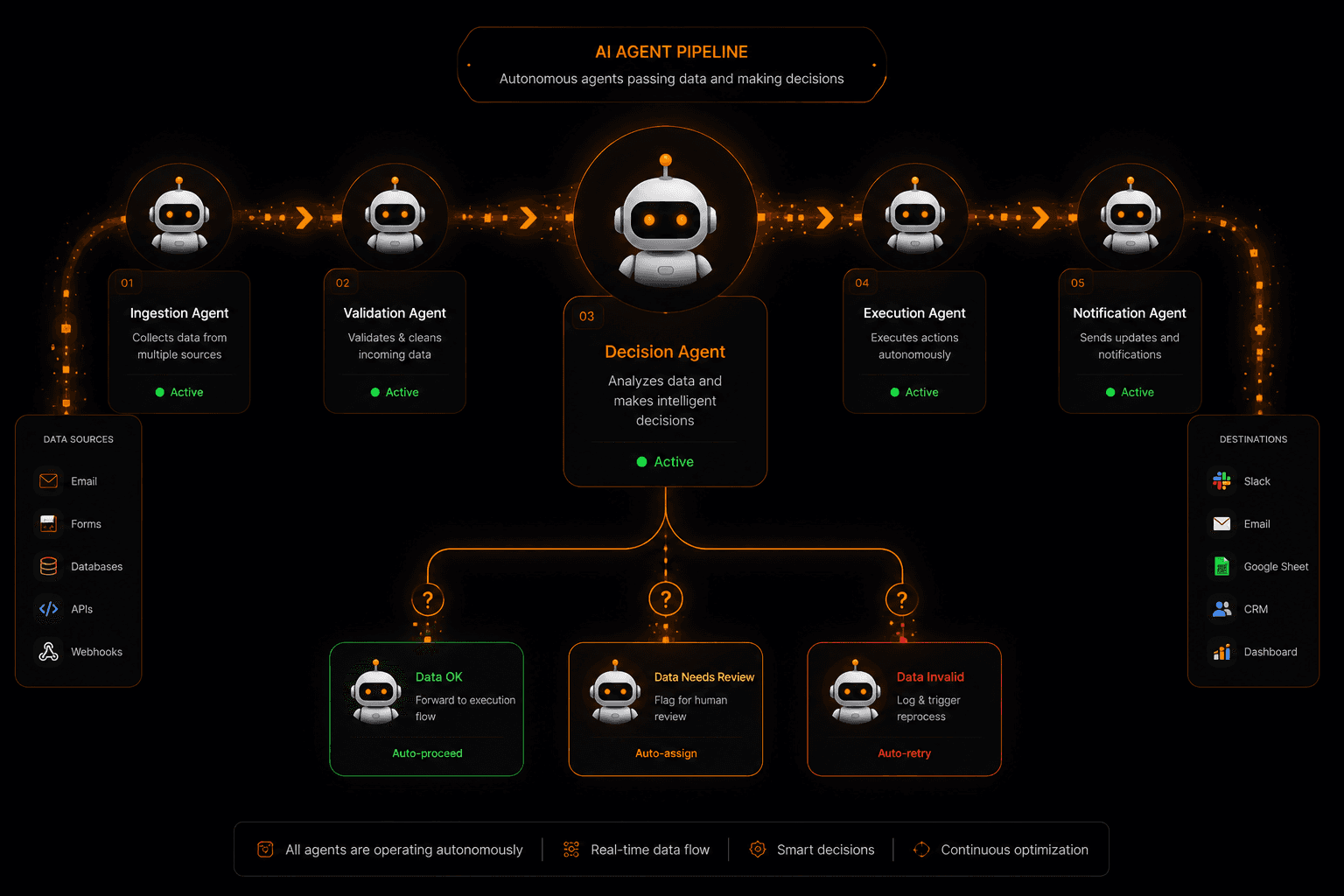
Most automation is reactive: trigger fires, actions run, done. Agentic workflows are fundamentally different. Instead of following a hardcoded sequence, an agentic workflow has an AI that decides what to do next based on what it observes — reading outputs, evaluating results, and choosing the next action dynamically. That shift changes everything about what automation can accomplish.
What are agentic workflows?
An agentic workflow is one where an AI agent — not a static rule set — determines the path through a process. Traditional automation: “Step 1 always leads to Step 2.” Agentic automation: “After Step 1, the agent reads the output and decides whether to go to Step 2, Step 3, retry Step 1, ask a human, or stop entirely.”
The agent isn't just generating text — it's acting as an orchestrator, choosing tools, interpreting results, and adapting its plan based on what it learns. This makes agentic workflows vastly more capable at handling tasks that involve ambiguity, exceptions, or multi-step reasoning.
Agentic workflows vs traditional automation
| Dimension | Traditional Automation | Agentic Workflow |
|---|---|---|
| Decision logic | Hardcoded if/else rules | AI decides dynamically |
| Handles unstructured data | No — requires structured fields | Yes — reads and reasons over text |
| Exception handling | Pre-defined error branches | Agent adapts to unexpected outputs |
| Multi-step reasoning | No | Yes — plan, act, reflect, retry |
| Output generation | Data transformation only | Generates text, summaries, decisions |
Multi-agent pipelines — when one agent isn't enough
Multi-agent pipelines chain multiple specialized agents together. Each agent handles one part of the process and passes its output to the next. This mirrors how human teams work: a researcher gathers information, an analyst evaluates it, a writer drafts the output, and a reviewer checks it before it goes out.
Common multi-agent pipeline structure on Vendarwon Flow:
- Ingestion agent: Reads the incoming trigger data (email, form, webhook) and extracts structured fields
- Validation agent: Checks the extracted data for completeness and quality
- Decision agent: Evaluates the validated data and determines the right action path
- Execution agent: Performs the actual actions (CRM update, email send, ticket creation)
- Notification agent: Summarizes the outcome and notifies the relevant humans
A real example: AI-powered inbound lead handler
Here's what an agentic lead workflow looks like end-to-end:
- Trigger: New form submission received via webhook
- Ingestion: Agent reads the form data, extracts company name, role, and message intent from the free-text field
- Validation: Agent checks if the email is real, the company exists, and the intent is genuine (not spam)
- Scoring: Agent scores the lead 1–10 based on company size, role seniority, and message urgency
- Decision: Score > 7 → route to sales Slack + calendar link. Score 4–7 → enter email nurture. Score < 4 → archive.
- Execution: CRM record created, appropriate email sent, Slack notification fired
- Notification: Sales rep gets a Slack DM: “High-value lead from [Company]. Score: 9/10. Here's the context: [summary].”
A human seeing this for the first time might assume 3–4 employees handled this process. It's one agentic workflow, running automatically in under 30 seconds.
How Vendarwon Flow implements agentic workflows
Vendarwon Flow's execution engine supports multi-agent chains through its AI nodes and pipeline feature. Each AI node in a workflow can read all prior context (trigger data, previous node outputs, loop state) and use that to generate its output. Condition nodes then branch based on those outputs.
For more complex use cases, pipelines chain multiple Vendarwon workflows together — the output of one becomes the trigger for the next, with full context passing between them. This lets you build systems where different “agents” handle specialized parts of a larger process.
When to use agentic workflows vs simple automation
Not every automation needs agentic intelligence. Use agentic workflows when:
- Input data is unstructured (email bodies, PDFs, customer messages)
- The right action depends on context that can't be pre-defined in rules
- You need AI-generated output (summaries, drafts, scores, classifications)
- Exceptions are common and hard to anticipate
- Multiple steps require reasoning to chain correctly
Use simple rule-based automation when:
- Inputs are always structured (a form with fixed fields)
- The action is always the same regardless of content
- Latency is critical and you can't afford an AI inference step
- The workflow is simple enough that a condition node handles all cases
Build your first agentic workflow
Describe your multi-step process in plain English. Vendarwon Flow builds the agentic workflow — AI nodes, conditions, and all — automatically.
Start building →